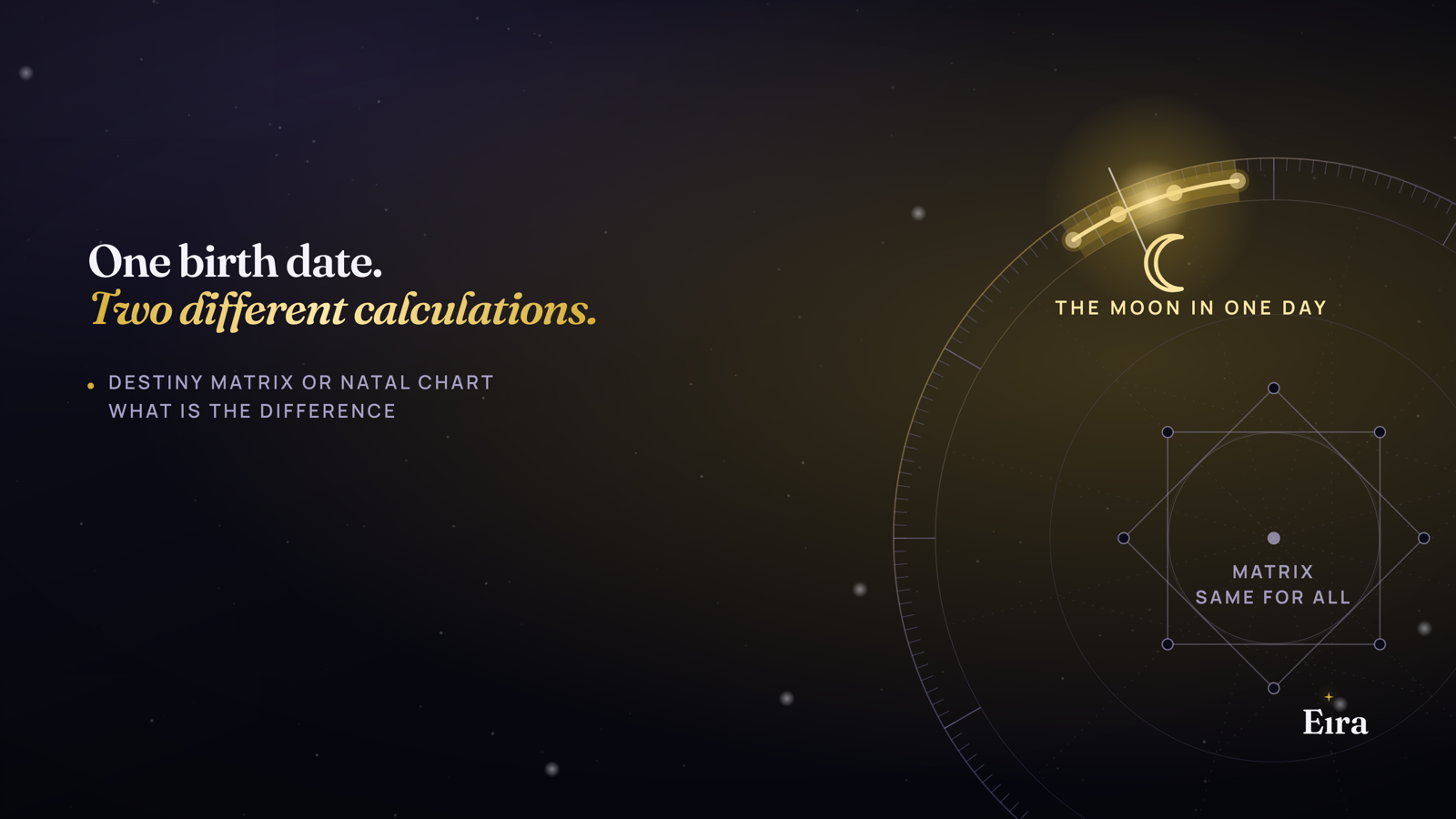
You type your birth date into one app and get a diagram of numbers tied to 22 archetypes. You type the same date into another — plus a time and a city — and get a wheel of planets spread across signs and houses. The first is a Destiny Matrix, the second a natal chart, and both are sold as a reading "based on your date of birth." The difference has nothing to do with which picture looks nicer. It comes down to what each method actually calculates.
People ask about this a lot, usually in one of two ways: "Which one is true?" or "Why does one say this and the other say something completely different?" What follows is a fair comparison, not a fight: how the Destiny Matrix works, how a natal chart works, why everyone born on the same day shares one matrix but not one chart, and how to tell which tool fits what you want to know.
The short answer: two methods, two sets of inputs
The Destiny Matrix and the natal chart are two different methods that start from different data. Neither is "the correct one." They simply answer different questions.
The matrix works with the numbers in a calendar date. The natal chart works with the actual position of the sky above a specific place on Earth at a specific moment. Everything else follows from that: what you have to enter, what you get back, and why two people born on the same day match in one system and differ in the other.
What the Destiny Matrix calculates
The method takes the day, month and year of birth and, by adding digits, reduces them to a set of numbers from 1 to 22. If a result comes out above 22, its digits are added together again. Each number stands for one of 22 archetypes, in a system modelled on the major arcana of the tarot. Those numbers are then placed into a diagram where each position carries its own meaning: personal traits, life tasks, relationships, money.
Take March 15, 1995. The day gives 15, the month gives 3, and the year gives 1 + 9 + 9 + 5 = 24. That is more than 22, so the digits are added again: 2 + 4 = 6. The remaining positions in the diagram are derived from these numbers according to the method's rules.
Time and place play no part. Two people born on the same day in different cities get an identical matrix. So do two people born on the same day, one at dawn and one just before midnight.
The method is fairly recent. It is usually credited to Natalia Ladini and her books from the 2000s. At heart it is numerology: meaning is assigned to a number rather than drawn from an observation. That does not make it useless. Plenty of people find that the language of archetypes helps them put into words something they have long felt about themselves. It just helps to be clear about what the method takes in.
What a natal chart calculates
Astrology takes the date, the exact time and the place of birth and works out where the Sun, the Moon and the planets really were at that moment, relative to the horizon of the birthplace. From that come the degrees, the signs, the houses and the angles between planets, known as aspects.
Each of the three inputs does its own job:
- The date fixes the positions of the slow-moving planets and, almost always, your Sun sign. The Sun moves about one degree a day.
- The time fixes the Ascendant (the sign rising over the horizon at the moment of birth) and the houses. The Ascendant runs through all twelve signs in a single day, about two hours per sign on average. Then there is the Moon: it moves fast, 12 to 15 degrees a day, and can change signs within one day.
- The place sets the horizon the whole chart is built on, and the time zone. Eight o'clock on a clock in Kyiv and eight o'clock in New York are two different moments as far as the sky is concerned.
Time moves the houses; place sets the frame of the whole chart. For a closer look at what you lose without a birth time, see why birth time matters in a natal chart.
One day, different skies: an example
Picture everyone born on March 15, 1995. They all share one matrix.
Now look at the sky. The Sun sits at about 24° Pisces all day, so for the Sun the date really does settle almost everything. The Moon is another story. A baby born in Kyiv at 3 a.m. has the Moon at roughly 28° Leo, in the last degrees of the sign. A baby born in the same city at 8 p.m. has it at roughly 8° Virgo. One calendar day, two different Moons: a fiery one that needs to be seen, and an earthy one that calms down once everything is sorted and in its place. Those are two different answers to "how do I recover after a hard day?" — more on that in the Moon in your natal chart.
Count every time zone on Earth and the calendar date of March 15, 1995 lasted almost two full days. Over that stretch the Moon travelled from about 20° Leo to about 18° Virgo — close to thirty degrees — and in every city the Ascendant went through all twelve signs. All of those people share one matrix and have very different natal charts.
That does not mean the matrix "gets it wrong." It simply never asks the question that time and place answer.
Where the line falls
In short:
- The matrix works with the numbers of a calendar birth date.
- The natal chart works with the actual position of the sky above a particular spot on Earth at a particular second.
So the first needs only a date, while the second also needs a time and a place, or there is nothing to calculate. Here are the four points where the two methods part ways most clearly.
What you have to enter
For the matrix, just the date. For a natal chart, the date, time and place. You can still build a chart without a time, but the Ascendant and houses will be approximate and the Moon will be off: calculated for noon, it can be out by as much as 7–8 degrees.
What you get back
The matrix gives you a set of archetype numbers in fixed positions. A natal chart gives you twelve signs, twelve houses, the position of every planet down to the degree and minute, and the angles between them. This is not about more or less information. It is a different kind of information: symbols versus coordinates.
How two people born on the same day differ
In the matrix, they don't. In the natal chart, they differ by Moon, Ascendant and houses, and sometimes by the Moon's aspects to other planets. That is why twins born twenty minutes apart share a matrix but can have natal charts with different houses.
Whether the inputs can be checked
Planetary positions in a natal chart are astronomy. Anyone can open an ephemeris (a table of planetary positions) and check what degree the Moon was in at a given moment. Interpreting those positions is astrology, and it remains interpretation. In the matrix there is nothing to check except the arithmetic: the numbers are exact, but the meaning attached to them comes from the method itself.
That is the real difference in precision. A natal chart is not "truer" by default. It is more precisely tied to you — to your moment and your place — rather than to a date you share with hundreds of thousands of people around the world.
Which one suits you
If you want the language of numbers and archetypes
The matrix is your tool. It is easy to calculate, it does not need a birth time, and it gives you a clear set of images to think about yourself with.
If you want exact degrees and the "why"
That is the natal chart. It shows not only what you are like but where in life it plays out (houses), what it is connected to (aspects), and why you behave differently from someone else with the same Sun sign. A good place to start reading one is Sun, Moon and Rising.
If you want both
You can use both. They do not contradict each other; they answer different questions. Just don't try to use one to verify the other.
How to see the difference for yourself
- Work out your matrix from your birth date. Any online calculator will do. Write down the main numbers.
- Build your natal chart with your exact birth time and place.
- Look at your Moon and your Ascendant. If your Moon sits in the first or last few degrees of a sign, it shows clearly how much the result depends on time: born a few hours earlier or later, you might have had the Moon in the neighbouring sign. Your matrix would not have changed by a single number.
- Compare what rings true. Not "who is right," but which language describes the specific situation you are thinking about more precisely.
What to do and what to avoid
⚖️ Do
- If you don't know your exact birth time, ask your parents, or check your hospital discharge papers or birth certificate if the time is recorded there.
- If you want to try both methods, treat them as two languages rather than two sides of an argument.
⛔ Avoid
- Comparing the two methods head to head, as if one could check the other.
- Treating different results as a mistake. These are different coordinate systems, not two versions of the same one.
Your natal chart in Eira
Eira works with the natal chart: the real sky at the moment you were born. The app does not calculate a Destiny Matrix.
To build the chart it needs your birth date, time and place. From the place, Eira works out the time zone in effect on your birth date. Planetary positions are calculated in the tropical zodiac, and houses use the Placidus system, the most widely used one in Western astrology. If you don't know your birth time, you can tick "I don't know my exact birth time": the chart is then built for noon and its houses are approximate. You can add the time in your profile later, and the chart will be recalculated.
What to look at next in your chart: the elements and the aspects. And if you have a specific question, ask Eira in the chat — how to ask Eira explains how to phrase it so the answer is actually about you.
Frequently asked questions
What is the main difference between the Destiny Matrix and a natal chart?
The Destiny Matrix is calculated from the birth date alone: the day, month and year are reduced to numbers from 1 to 22, each one an archetype. A natal chart is built from the date, time and place of birth and shows where the Sun, the Moon and the planets actually were at that moment, in which signs and houses.
Why do people born on the same day have different natal charts?
Because the sky changes noticeably over a single day. The Moon moves 12 to 15 degrees and can change signs, the Ascendant passes through all twelve signs, and the houses shift with it. The matrix does not account for any of this, so everyone born on the same day gets the same one.
Is the Destiny Matrix a form of astrology?
No. It is a numerological method: it works with the digits of a date, not with the positions of planets. The word "destiny" in the name doesn't make it astrology, and a diagram of archetypes is not a map of the sky.
Can you make a natal chart without a birth time?
Yes, with caveats. The signs of the Sun and the slow-moving planets will almost always be right. If the time is completely unknown, the chart is usually cast for noon. The Moon can then be up to 7–8 degrees off in either direction, and the Ascendant and houses become approximate.
Do the Destiny Matrix and the natal chart contradict each other?
No. They answer different questions and work from different data. If the results don't match, it doesn't mean one of them made a mistake. They are two different ways of describing a person.
To see where the Sun, the Moon and the planets were at the moment you were born, and which houses they fall in, open your natal chart in Eira. All it needs is your birth date, time and place, and you can use the app free for the first seven days.