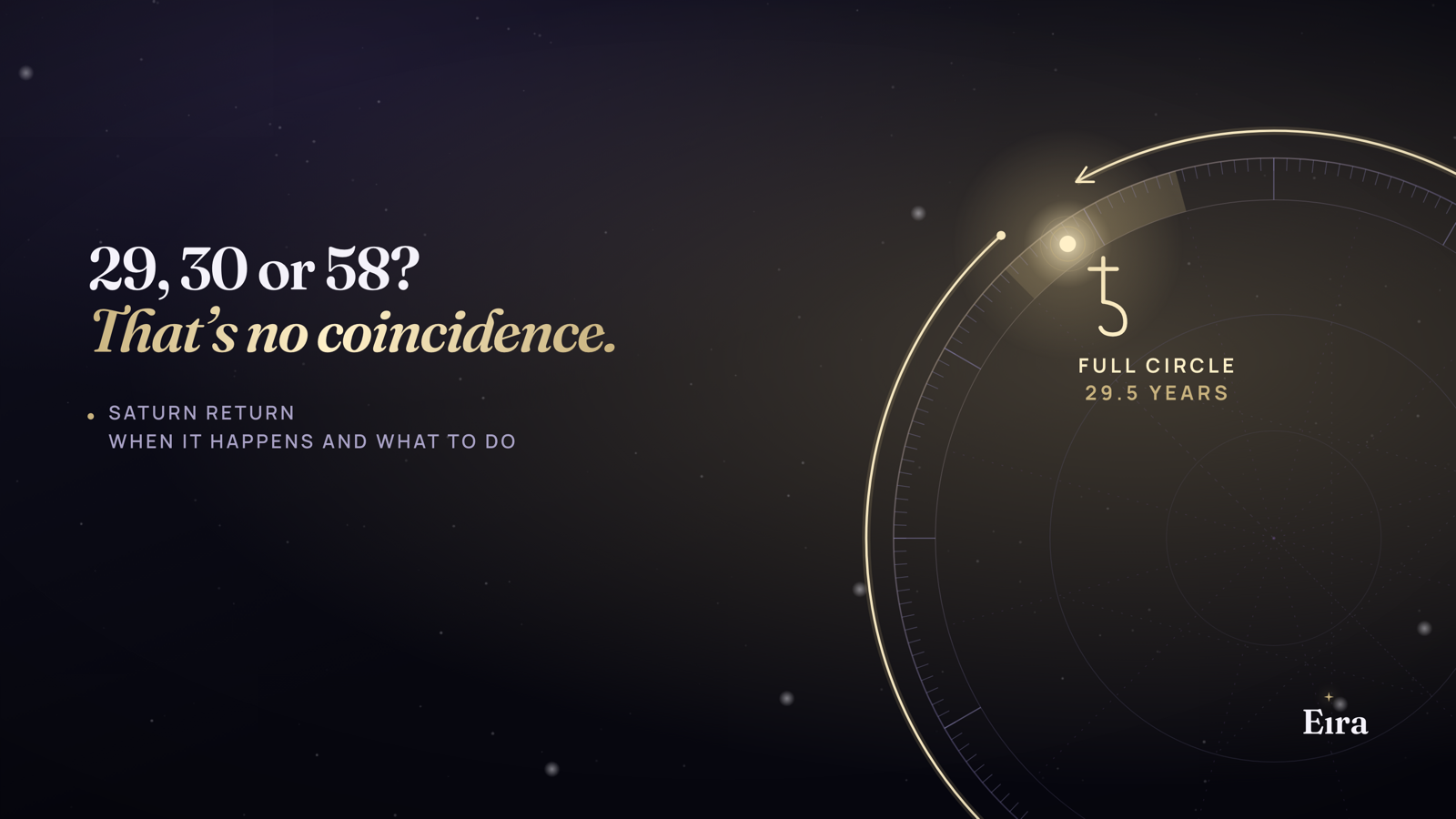
You're around 29, 30 or 58, and suddenly you want to walk away from something you've spent ten years building. Or the opposite: you finally want to commit to one thing and stop spreading yourself thin. A job that felt fine in spring starts grating by Monday morning. A relationship where "everything's okay" suddenly needs a conversation about where the two of you are actually going. Your city, your flat, your career — things you haven't questioned in years — turn into open questions.
This isn't a crisis out of nowhere. It's Saturn coming back to where it stood on the day you were born.
Below: what a Saturn return is, how to find it in your own birth chart in three steps, who is going through one right now, and what to do with it.
What is a Saturn return?
Saturn takes roughly 29.5 years to travel around the zodiac. In that time it moves through all 12 signs and comes back to the exact point it occupied in your natal chart. That homecoming is your Saturn return. The first arrives around age 29–30, the second around 58–59, and the third around 88.
A Saturn return isn't a single day. It's a window of a year and a half to two years while Saturn moves close to its natal degree. Often it crosses that degree three times — forward, back, then forward again — because for several months each year it moves retrograde.
In a chart, Saturn stands for time, responsibility and structure: the things you build, and the things that end up holding you in place. In our piece on Saturn in the 7th house we put its key trait this way: Saturn doesn't take anything away — it sends the bill in advance. During a return, the bill for the last thirty years comes due.
The core question: chosen, or just inherited?
Saturn asks: is what you've built over the past thirty years really yours, or did you inherit it by default? And it won't let go until you answer with actions, not words.
That's where the familiar "everything is falling apart" feeling comes from. What usually falls apart is whatever rested on "that's just how it's done". What you genuinely chose has a real chance of standing. Many people later look back on this period as the moment their life first became their own. From the inside, though, it rarely feels pleasant.
What it looks like in real life
- You catch yourself working in a field you picked at seventeen — and can't quite remember why you picked it.
- The "so where is this going?" conversation you've dodged for years becomes unavoidable: either you move in and build something together, or you part honestly.
- For the first time you take on what you used to hide behind other people's opinions: your own project, your own money, your own decision — no more "someone told me to".
- The tiredness turns out not to be tiredness but resistance: you're worn out by a structure you built without asking whether you wanted it.
- Parents, a boss, an older partner stop being "the ones who decide" — and you find yourself in that seat.
- At the second return, around 58–59, the same question sounds different: do you spend the coming years on what you still need to prove to someone, or on what is truly yours?
How to check your Saturn return in your chart
Three steps, ten minutes.
Step 1. Find Saturn's sign and degree
Open your natal chart and find Saturn: its sign and degree. That's your personal return point. The degree matters, not just the sign. Saturn spends about two and a half years in each sign, so someone with Saturn early in a sign and someone with it late in the same sign will hit their returns at different times.
Step 2. Compare your age and where Saturn is now
If you're 27–31, 56–60 or 85–89, you're inside one of the three return windows. The first is the most recognisable: it's when adult life is first stress-tested.
Then compare your Saturn's degree with Saturn's current position (dates are in the section "Who is having a Saturn return now"). While the gap between them is under 3–4 degrees, you're in the most intense stretch of the return.
Step 3. Look at Saturn's house
The house shows where the review will play out: career, relationships, your own business, where you live. Houses depend on your time of birth — without an exact time, the chart has no houses, so lean on the sign and aspects instead. Our article on why birth time matters in astrology explains why. All twelve houses are covered below.
Who is having a Saturn return now
Saturn is moving through Aries from February 2026 to April 2028. So everyone with natal Saturn in Aries is in their return right now. That means people born:
- First return (age 28–30): 7 April 1996 – 9 June 1998, and late October 1998 – 1 March 1999;
- Second return (age 57–59): early March 1967 – late April 1969;
- Third return (age 86–89): 25 April – 18 October 1937, 14 January 1938 – 6 July 1939, and 22 September 1939 – 20 March 1940.
Boundary dates are accurate to within a day. If you were born on a day when Saturn changed sign, check the degree in your chart.
Within those ranges, the degree decides the timing:
- Saturn at 0°–15° Aries — your window runs from February 2026 to March 2027. That covers people born April 1996 – early May 1997, November 1997 – January 1998, and March 1967 – early April 1968.
- Saturn at 15°–30° Aries — your window runs from March 2027 to April 2028. That covers everyone else on the list above born in 1997–1999 and 1968–1969.
Right now, in autumn, Saturn is retrograde. On 21 October it sits at about 10° Aries; on 11 December it turns direct at 7°55′ and starts moving forward again. So the people closest to an exact return at the moment are those with Saturn between 8° and 15° Aries: from December to mid-March 2027, Saturn crosses those degrees for the third and final time. That includes, for example, people born mid-March to early May 1997, May to mid-October 1967, and late January to early April 1968. The third pass often feels like a conclusion: a decision that took shape over spring and summer turns into action.
If your natal Saturn is in Pisces, you've most likely already been through your return, sometime between 2023 and early 2026. If it's in Taurus, yours is still ahead, starting in April 2028.
A Saturn return in Aries: the question it asks
Everyone going through a return right now has Saturn in Aries, and the sign sets the tone of the test. For Aries it's about the right to want things and to act in your own name. Where are you waiting for permission when you could have decided long ago? And where do you charge in headfirst so you don't have to notice your own doubts?
The scenes are familiar: leaving a job where you're valued but never consulted; starting something of your own even though "staying would be safer"; saying "I want this" for the first time without apologising and without a fight. Saturn in Aries doesn't teach courage in general. It teaches the kind of courage you're still willing to stand behind a year later.
Where the review happens: Saturn by house
Saturn's house in your natal chart is the area of life where the return shows up most. Find yours.
Saturn in the 1st house
A review of how you see yourself. The question: who have you become — yourself, or the role people expected you to play? Style and the way you carry yourself often change: you want to look the way you feel, not the way you're "supposed to".
Saturn in the 2nd house
Money and self-worth. It becomes clear how much you actually earn for your effort and where it goes. Time to put your income in order and stop settling for less "for now".
Saturn in the 3rd house
Words, learning, your immediate circle. You want to finish that course, get the qualification, finally say out loud what you've held back for years. Relationships with siblings get tested for maturity too.
Saturn in the 4th house
Home, family, roots. The question of where you live and why: a place of your own, a move, separating from your parents' household — or, the other way round, taking responsibility for it. Foundations, in the most literal sense.
Saturn in the 5th house
Creativity, romance, children. A hobby wants to become real work — or honestly stay a hobby. Romances get tested for seriousness, and the question of children stops being abstract.
Saturn in the 6th house
Daily work rhythm and health. A routine that was "somehow holding up" stops holding, and your body is the first to tell you the load isn't yours to carry. A good time to build a schedule you actually chose.
Saturn in the 7th house
Partnership. A relationship either steps up to a new level of commitment or ends honestly. The same goes for business partnerships. More in our article on Saturn in the 7th house.
Saturn in the 8th house
Shared money, debt, intimacy. Loans, inheritance and joint budgets need clarity. In close relationships the question is trust: who you're truly ready to open up to. More on this area in the 8th house in your natal chart.
Saturn in the 9th house
Beliefs, education, wider horizons. Views you absorbed from family or teachers get tested against your own experience. This is often when people start a second degree, move abroad or begin working internationally.
Saturn in the 10th house
Career and status. The textbook Saturn return: your title, your profession, your reputation. The question isn't "how do I climb higher?" but "is this the ladder I want to be on?". Many people change careers or go out on their own at exactly this point.
Saturn in the 11th house
Friends, communities, plans for the future. Your social circle thins out: the people who stay are the ones you're heading the same way with now, not out of old habit. Your dreams get reviewed — which of them are still yours?
Saturn in the 12th house
Inner life, exhaustion, what stays hidden. The review is quiet and barely visible from outside: fears, habits, old guilt. Therapy and genuine rest work well here — things that once felt like a luxury.
What else to look at in your chart
- Saturn's sign and house — the theme and the area of the return.
- Aspects from the Sun, Moon or Venus to Saturn — how personal the test feels. If Saturn is linked to the Sun, the question becomes "who am I?"; to the Moon, "where do I feel safe?"; to Venus, "who and what do I love?". Our guide to finding aspects in your natal chart in 10 minutes shows how to spot them.
- Retrograde natal Saturn. If Saturn is retrograde in your birth chart, the return is often quieter on the outside but longer on the inside. What retrograde planets mean in a birth chart is covered in a separate article.
If other slow transits are running alongside your Saturn return, our breakdown of which transit matters most for you right now will help you sort out which one leads.
First, second and third returns: how they differ
The first, around 29–30, stress-tests adult life. For the first time, choices made at twenty meet their consequences. Hence the career changes, marriages and break-ups, moves, and the first truly serious commitments.
The second, around 58–59, reviews what you've built. The question is no longer "who should I be?" but "what do I spend the next years on?": what to hand over, what to finish, what to finally do for yourself. People often change their working pace at this point, or take up something they've put off all their lives.
The third, around 88, is about taking stock and passing on experience. The theme: what remains after you, and who you hand it to.
What to do
- Pick one structure in your life — a job, a relationship, a habit — and ask yourself honestly: am I continuing this by choice or by default?
- Rebuild what you've chosen and close what you haven't. Slowly and like a grown-up: agreements, deadlines, a plan on paper.
- Take responsibility in small but real steps: one conversation, one application, one budget — instead of "someday".
What to avoid
- Breaking everything at once. Quitting, splitting up and moving in the same week isn't an answer to Saturn's question; it's running away from it.
- Demanding a revolution from yourself. Saturn asks for an honest review of the foundations, not a demolition.
- Comparing yourself with people your age. Everyone's return plays out in their own house and on their own schedule.
Dates: Saturn is in Aries from 14 February 2026 to 13 April 2028 (it also made a brief visit to Aries from 25 May to 1 September 2025). Saturn has been retrograde since 26 July 2026 and turns direct on 11 December at 7°55′ Aries.
Frequently asked questions
At what age does a Saturn return happen?
The first comes at roughly 29–30, the second at 58–59, and the third at around 88. The exact timing depends on Saturn's degree in your chart, and the window itself lasts a year and a half to two years.
How do I know if I'm in my Saturn return right now?
Find Saturn's degree in your natal chart and compare it with where Saturn is today. If you were born between April 1996 and June 1998 (or late October 1998 and March 1999), or between March 1967 and April 1969, your Saturn is in Aries and your return falls in 2026–2028.
Is a Saturn return always hard?
No. It's a period of testing, not punishment. What usually goes is whatever was running on autopilot, while what you chose yourself becomes more solid. It gets hard when you hold on with all your strength to something that's no longer yours.
Can I work out my Saturn return without a birth time?
Yes, the essentials. Saturn's sign and degree can be found almost exactly from your birth date alone: it moves less than a seventh of a degree a day. Without a time, though, you won't have the house — the area of life where the review plays out.
How long does a Saturn return last?
About a year and a half to two years around your natal degree. Because of retrograde motion Saturn may cross that point three times, and usually one of those passes — not necessarily the first — is the one you feel most.
Your natal Saturn — its sign, degree, house and retrograde mark — is shown in your natal chart in Eira, on the "Planets" tab. You can also ask in the chat what this return means for your chart specifically. If you're just getting started, begin with our guide to reading your natal chart.